

The health intelligence layer for the rest of your life.
Findings connects your labs, medications, family history, and daily readings with peer-reviewed research and official guidance — so your health picture becomes a living plan.
Peer-reviewed sourcesAny lab, any country
Hi Mark,
Your results uncover some interesting patterns when looked at together. Nothing alarming — but a few things worth understanding now, while they're easy to act on.
Your LDL in context
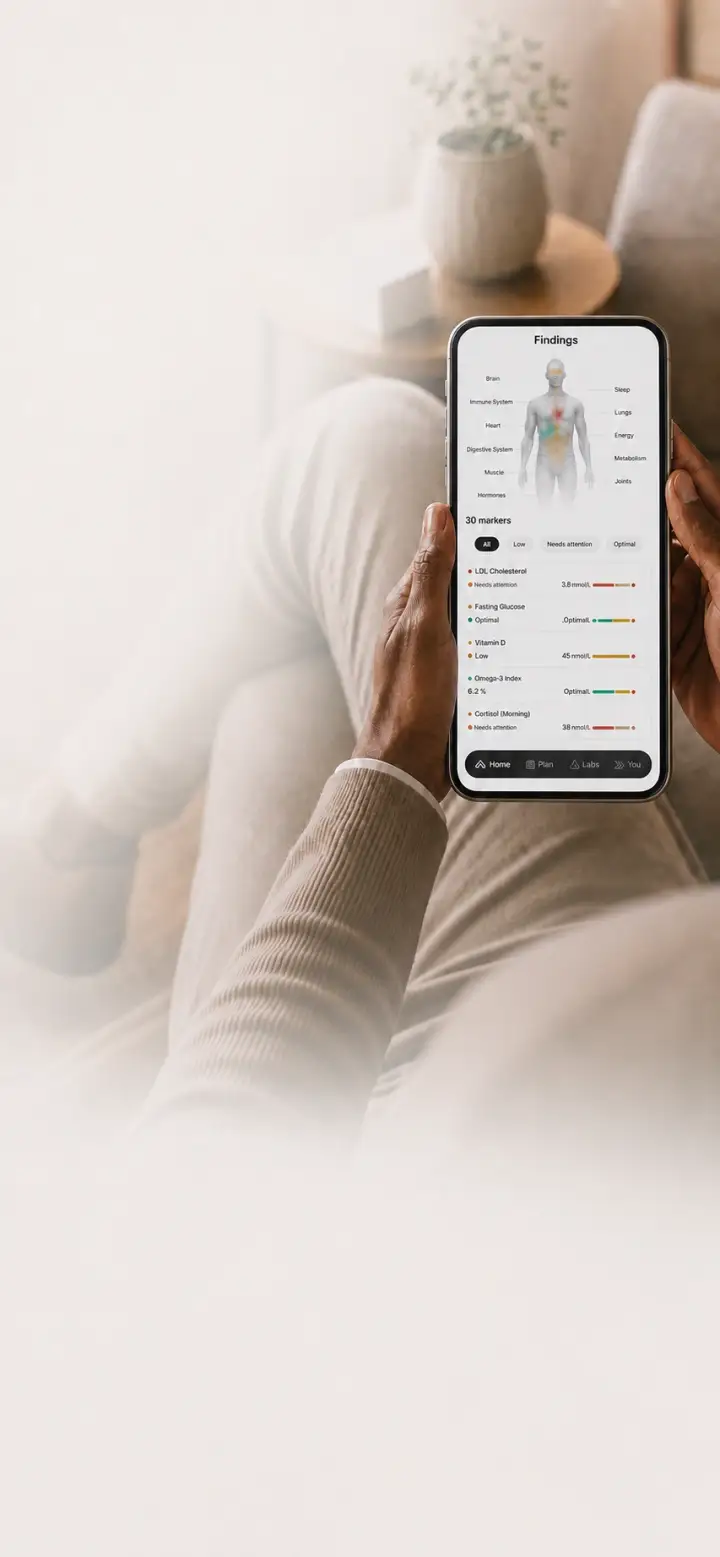
At 3.8 mmol/L your LDL is above the optimal range. What's interesting is that your fasting glucose, HbA1c, and ferritin are also trending slightly high — a combination that research links to reduced LDL clearance. Worth mentioning to your doctor alongside the cholesterol number.
A pattern across your daily readings
On days when your blood pressure was higher last month, your morning hsCRP was also elevated — 0.6 vs 0.4 mg/L on calmer days. This kind of correlation doesn't appear in any individual report, but it's useful context for understanding how your markers interact day to day.
Trends to keep an eye on
Your HbA1c has risen gradually over your last three panels (+0.15% per year), and LDL has also trended upward. Neither is urgent now — but catching a slow drift early gives you the most options. You're in a good position to stay ahead of it.
Tests worth adding to your next panel
- ApoB — Gives a more complete picture of cardiovascular risk than LDL alone — especially useful given your current profile.
- Fasting insulin — Would help clarify whether your glucose trend is diet-related or something to monitor more closely.
- Free testosterone — Vitamin D levels like yours can sometimes affect testosterone in men over 40. A simple test to have as a baseline.
Good next steps
- 1.Bring the ApoB and fasting insulin findings to your next appointment — they add useful context to what's already flagged.
- 2.Retest in 3 months to see if the trends continue or stabilise. Tracking over time is where the real picture emerges.
- 3.Ask your doctor about Vitamin D — levels in your range are common and often easy to address with simple supplementation.
It starts with you, not a file.
A short profile is enough for your plan teaser — one module unlocked, the rest outlined. Upload labs anytime to sharpen your preview.
Your health picture, finally connected
Heart, metabolic, thyroid, inflammation, kidney, liver, vitamins, blood, and daily readings, brought together so patterns are easier to see.
How it works
Creating your personal health intelligence
Profile first, then your watch plan, optional labs, and a layer that compounds — six steps from day one to decades of watch.
Start with a shorthealth questionnaireStart with a short
health questionnaire
A guided questionnaire covers age, sex, country, conditions, medications, and family history — the foundation of your health intelligence. Labs, genetics, and past records can come later.
Your intelligence planreveals on day oneYour intelligence plan
reveals on day one
Plan opens a decade-scale map from your questionnaire — priority watch items, review timing, panel gaps, and cited guidance tied to conditions and meds.
When you have results,upload sharpens the planWhen you have results,
upload sharpens the plan
Labs are optional to start. Upload a PDF or photo from any lab — we extract biomarkers, normalise units, and fold them into your watch plan. Your first report is included before membership.
A focused previewof what mattersA focused preview
of what matters
For chronic-care profiles, see up to three condition-picked markers — clinical and optimal ranges, scoped AI with source footers, and how they connect. The rest of the panel unlocks with membership.
Vitamin D · 25-OH
The intelligence layercompoundsThe intelligence layer
compounds
The Health Intelligence Spine ties profile, labs, trackers, meds, and cited rules into connection cards and trends — answers draw only from your stored data, not generic chat.
We remember everythingand remind you what's nextWe remember everything
and remind you what's next
Your timeline, review schedule, visit prep, and grounded Ask stay with you for decades. Findings keeps what you have logged and surfaces what to review next as your life, labs, and published guidance change.
2026
Keep your watch plan: full schedule. Visit prep, reminders, and plan updates with membership

Personalized ranges
Orange is normal
;Your optimal is green.
Labs show a reference band. Findings adds optimal ranges shaped by your age, sex, medications, history, and how markers relate.
See ranges personalized to youDemo · male, 48, statin, high latitude
Inside the lab reference band — below your personalized optimal zone for this profile (statin, latitude, age). Many reports would not flag a value here.
You are at 44 ng/mL — in range on your lab report, so it may show no flag. With your statin, treated blood pressure, and UK latitude, your optimal band is about 52–74 ng/mL, not the usual 30–60 ng/mL window. Worth rechecking after winter and discussing supplementation with your clinician.
Example insight for illustration only — not based on your health data.
Alongside your labs
Connect data you already measure.
Blood pressure, glucose, weight, and custom logs sit beside your biomarkers, so daily changes become part of the bigger picture.
Flexible reminder schedule
On days hs-CRP runs high, evening blood pressure averages 9 mmHg higher. Weight trend this month may shift triglycerides toward optimal at your next panel. Fasting glucose below 5.5 is projecting HbA1c from 5.4% toward 5.2%.
Example insight for illustration only — not based on your health data.
Designed to keep watch for decades
Everything you add makes the picture sharper, from labs and daily readings to records, genetics, reminders, and visit prep.
Guidance that stays current
Review topics from peer-reviewed sources — matched to your profile and country. Updates when your labs or life changes.
Clinical and optimal ranges
The lab’s printed band plus an optimal zone for your age, sex, meds, and history — so in range and right for you differ.
Lab-agnostic OCR
PDF or photo from any lab worldwide. We extract 150+ biomarkers, normalise units, and you confirm before save.
Clinical records import
FHIR exports from Apple Health or patient portals — vaccines, visits, and procedures in your timeline after you confirm.
Optional genetics context
Consumer raw-data files for cited discussion topics — educational only, not clinical genetic testing.
Medication-aware context
Active meds plus monitoring context from published guidance — for your prescriber, not dosing advice.
Daily health trackers
Pressure, glucose, weight, and SpO₂ — manual or synced. Readings feed the same picture as your labs.
Patterns across decades
How markers move and relate across panels — context for your clinician, folded into your living plan.
Private and encrypted
Encrypted in transit and at rest. We do not sell your data or train general AI on it. Export or delete anytime.
Lifelong health intelligence.
One membership.
Your plan starts from profile and published guidance, not a lab report. Membership keeps that picture compounding — trends, review timing, and reminders across the years ahead.
Annual
Full intelligence layer — living plan, labs, reminders, and export.
- Living plan, review schedule, and cited guidance
- Unlimited lab uploads with clinical + optimal ranges
- Trends and AI insights across your full history
- Review reminders matched to published guidance
- Medication-aware context and daily tracker logging
- Encrypted — never sold or used for model training
No payment today. Start with your profile.
Get started5-year
Watch for decades — auto-renews every five years.
- Everything in Annual
- ≈ $70/year effective rate
- Priority OCR processing
- CSV & PDF data export
- Early access to new biomarkers & features
No payment today. Start with your profile.
Get startedAdd health intelligence to your employee benefits package — billed per seat, invoiced annually.
- Seats for your entire workforce
- Anonymised team health trends for HR
- Bulk report upload & management portal
- SSO / SAML directory integration
- Dedicated account manager
- Priority SLA & support
- Invoice & purchase order billing
- GDPR-aligned data processing agreement
- Employee onboarding & education materials
- Custom integrations on request
Nothing to pay today · cancel anytime if you subscribe
When “you're fine”still left questions.
For people who kept getting normal-sounding answers, but still wanted the full picture.

Nikola J.
Financial director, 52
I pasted labs into ChatGPT for years — fine for one answer, then it forgot the last panel. Findings started from my profile and built a living plan I could keep. Twice-yearly uploads show what changed, what work panels skip, and when to review. That continuity is what I wanted.

Nikola J.
Financial director, 52

Oliwia K.
Architect, 41
I went through a rough patch with my health a few years back. My GP said ferritin was fine. Findings put it next to inflammation markers I had never connected, and flagged tests my last panel never ran. I print the plan before appointments now. Regular blood work feels like one story across years, not a stack of PDFs in a drawer.

Oliwia K.
Architect, 41
I went through a rough patch with my health a few years back. My GP said ferritin was fine. Findings put it next to inflammation markers I had never connected, and flagged tests my last panel never ran. I print the plan before appointments now. Regular blood work feels like one story across years, not a stack of PDFs in a drawer.

David R.
Software engineering lead, 44
A colleague had a stroke at 46 — fine on his last checkup. That stayed with me. I wanted intelligence for my age and family history that updates when new labs arrive. Findings reaches out a few times a year — watched over without health becoming a second job.

David R.
Software engineering lead, 44

Brielle M.
Small business owner, 49
I put my thyroid last for years. The work wellness panel says normal. Findings showed what that bundle often skips for someone my age on levothyroxine. Older labs landed in one timeline. I would have paid for that clarity years ago.

Brielle M.
Small business owner, 49
I put my thyroid last for years. The work wellness panel says normal. Findings showed what that bundle often skips for someone my age on levothyroxine. Older labs landed in one timeline. I would have paid for that clarity years ago.
Why I built Findings
She was a year and a half.I was in a hospital bed, wondering if I would see her grow up.
It was a mini-stroke. I was 37, and Mila was at home with my wife. What stayed with me afterward was not the scare itself. It was whether I had done enough while I still had time.
I had annual labs, an Apple Watch, a GP I trusted. Blood pressure ran high when my wife was pregnant; my blood test still said normal. What I did not have was anyone connecting what to watch at my age, whether markers were moving, or what to ask before a small drift became urgent.
In hospital I saw how clinicians read results against the risks that applied to me, alongside my meds and my history, not in isolation. That rigour is what you want in a crisis. I wanted it while I still felt fine, without waiting for the next appointment.
So I built Findings for health intelligence with that same rigour, between visits. Preview your first panel in setup; subscribe to keep watching.
Rade Joksimovic, founder
Questions, answered plainly.
What Findings does, what it does not do, how AI is used, how uploads work, and where clinician review still matters.