
What a living health plan looks like
Key takeaway
A health plan is the decades-long loop: profile, personalized list, upload anywhere, dual ranges and gaps, retest calendar and age milestones, and optional daily data beside labs. Each year should differ from the last.
Read more
Findings guides are written for general education and reviewed by qualified health professionals before publication. They are not medical advice.
Screening guidance matched to your risks, from the world’s leading health institutions:


This guide is the product walkthrough — what it feels like to use Findings across years, not the argument against mega-panels (see right-sized testing) or the engine architecture (see methods). You start with a profile, see a personalized marker list, test at any lab, upload results, and build a picture that updates when you cross age milestones, change medications, or when a marker drifts. One annual checkup is a habit; a health plan is what remembers what the habit forgot.
The checkup habit vs. a plan that compounds
Most responsible adults do the annual blood work, hear “you’re fine,” and file the report away. The ritual feels complete — you went, you were responsible. What it rarely leaves behind is a list of what is still untested for your profile, when to review again after a medication change, or what next year should prioritise when you cross an age threshold.
A health plan exists to carry that forward. Not another PDF explainer for one report — a schedule, gap list, and longitudinal picture that updates when you do. The right-sized testing guide explains why employer and bundled panels are structurally generic; this guide explains what Findings does with your profile once you are inside the product.
It starts with your profile, not the draw
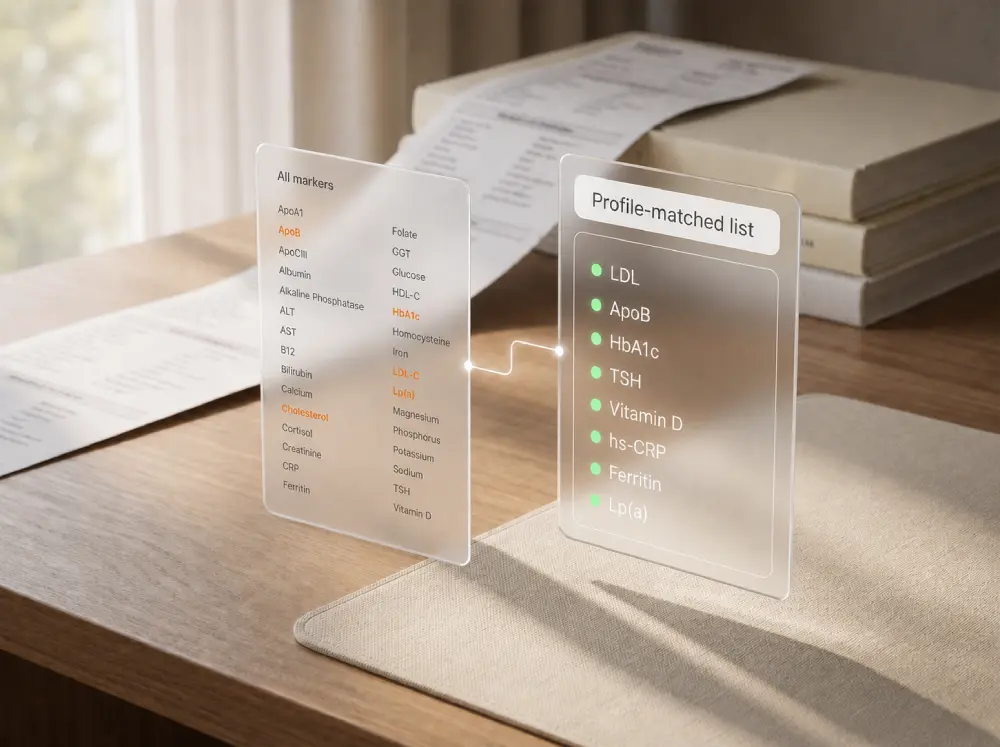
Findings starts with a short questionnaire — conditions, medications, family history, behavior, country. That context drives which screening topics and markers belong on your list from peer-reviewed guidance, not the same mega-panel every adult receives. A 52-year-old woman on levothyroxine with a parent who had early heart disease should not inherit the same short panel as a healthy 28-year-old man — yet employer checkups often look surprisingly similar.
Medications change which follow-up labs the literature discusses. After a statin start or dose change, lipid guidance supports a recheck in weeks to months rather than waiting a full year[9]. After a levothyroxine change, the American Thyroid Association suggests rechecking TSH about 4 to 8 weeks later, because hormone levels need that long to reach steady state[15]. The profile is the input; the marker list and schedule are the output — and you can update the profile whenever life changes.
Your marker list — before and after upload
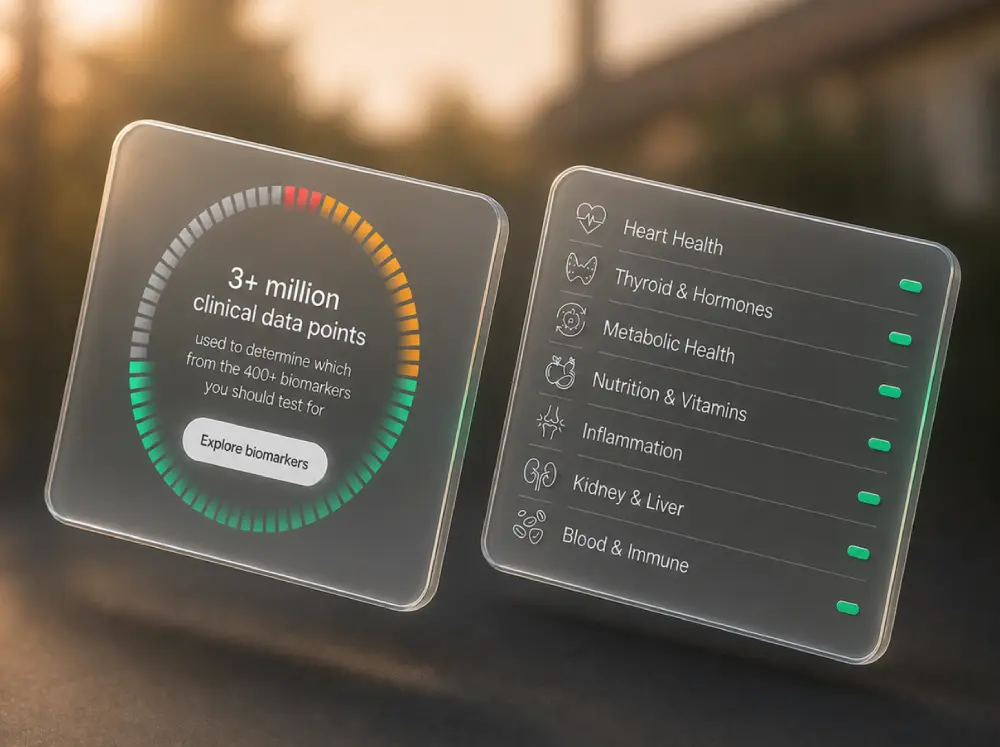
After your profile, you see a personalized preview: starter markers with cited reasons and one plan module unlocked. Membership unlocks the full list and schedule. The list is built from published guidance matched to your age, sex, medications, family history, and country — not the same form for every adult. How that matching works technically is on the methods guide; why we reject volume-first panels is on the right-sized testing guide.
Before any upload, the list tells you what to discuss at your next draw. After labs arrive, the same plan connects results to dual ranges, trends, body-map views, and retest timing. Browse the 400+ biomarkers the engine recognizes from any upload.
Test anywhere — we don’t sell blood
Membership is $99.99/year for software. You arrange draws at any lab worldwide and upload PDFs or photos; OCR recognizes 400+ markers, normalizes units between systems such as mg/dL and mmol/L, and keeps history comparable across labs and countries. A draw in London, Singapore, or Toronto sits on the same timeline as last year’s panel — and because Findings does not sell blood, bundle phlebotomy, or mark up a fixed panel, the intelligence layer stays with you when you move cities or switch employers.
Dual ranges, not one orange band
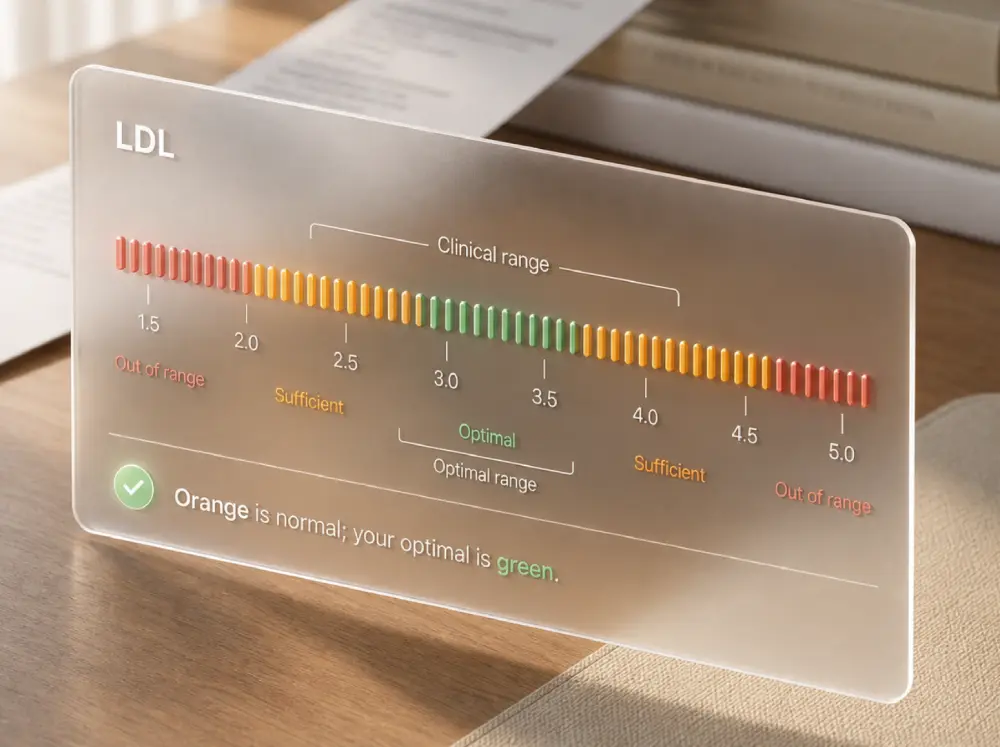
Labs print one clinical band for everyone on the page. Findings also shows an optimal range recalculated for your profile, so “in range” and “right for you” are not the same question. An LDL cholesterol value inside the lab’s band can still sit above where cardiovascular guidance would target it given your age, risk factors, and statin use[9].
The same gap between “normal” and “optimal” shows up across markers. HbA1c between 5.7% and 6.4% is classified as prediabetes rather than simply normal[4]; vitamin D of 20 ng/mL (50 nmol/L) is considered sufficient for most people, with risk of deficiency rising below 12 ng/mL[11]; and ferritin sits inside a wide lab band that does not reflect every context[19]. Both zones appear on the range bar — orange sufficient, green optimal, red out of range — so you can discuss drift with your clinician instead of stopping at “normal.”
Screening topics change as you age
Published guidance adds and shifts review topics across decades. A few examples of how the list changes as you age:
- Colorectal screening now begins at age 45 rather than 50[5]
- The USPSTF recommends biennial mammography for women from age 40[6]
- PSA-based prostate screening for men aged 55 to 69 is a shared, individual decision[7]
- Bone density screening is recommended for women 65 and older[8]
Thresholds for ongoing markers move too. Since 2017, blood pressure of 130/80 mmHg or higher is classified as stage 1 hypertension — a lower bar than the older 140/90[10]. And statin guidance frames primary-prevention decisions for adults aged 40 to 75 around 10-year cardiovascular risk[2]. A health plan surfaces these as cited discussion topics for your clinician as you cross each age threshold — not orders from software, and not a copy of last year’s list.
Gaps are part of the plan
When a marker that matters for your profile has never been tested, the plan surfaces it as a gap — with a cited reason, not a scare headline. A gap might be lipoprotein(a), which national lipid guidance suggests measuring at least once in every adult because levels are largely genetic and stay stable for life[12][14]. Because that value rarely changes, a single measurement is generally enough to establish a lifetime baseline[13].
Other gaps appear when you upload a partial panel — the engine knows what was not on the page, not only what was. Closing a gap is a conversation with your clinician; Findings organizes what is missing and why the literature mentions it for someone like you. Over years, the gap list should shrink while the plan list deepens.
Daily readings sit next to labs
Blood work is episodic; blood pressure, weight, glucose, and SpO₂ can be daily. Findings lets you log or sync those readings alongside labs so patterns show up across years — for example, evening pressure running higher on weeks when inflammatory markers drift up. Because hypertension is now defined at 130/80 mmHg[10], a home log that trends toward that line is worth seeing in the same view as your panels, not in a separate app you never open before a visit.
Trackers are optional — the product does not ask you to quantify everything. But when you already measure at home, the data belongs in one longitudinal picture: profile, labs, daily data, and review timing in one place. See the living plan for how single readings become a story.
A plan that evolves
Retest timing follows your values and trends rather than the calendar:
- Cholesterol guidance supports rechecking lipids weeks to months after a treatment change, not at the next annual visit[9]
- Diabetes screening can repeat about every three years when results are normal[3]
- eGFR and other kidney markers are monitored on a cadence set by risk under published kidney guidance[18]
Life changes matter too: a new diagnosis, pregnancy, a major weight change, or stopping a medication all belong in the profile so the plan does not compare this year’s labs to last year’s as if nothing happened. That is what “living plan” means in practice — stable markers move to longer intervals, while drift pulls a review forward with a cited reason.
What changes after your first upload
Before labs, you still get a profile-matched preview — cited starter markers and screening counts. After your first upload, dual ranges activate on your full panel during setup preview; membership unlocks trends across panels, ongoing uploads, and the full living plan. Body-map views make drift visible across systems where a single PDF line item cannot.
During setup you can preview your first panel in full; membership unlocks ongoing uploads, chat, trackers, and export when you are ready. The first report is not the finish line — it is the moment the plan stops being hypothetical and starts tracking real trajectories.
What membership keeps compounding
Software membership is what turns isolated checkups into a decades-long picture: a retest calendar, trend lines across labs and countries, AI summaries scoped to your data, visit-prep export for ten-minute appointments, and plan updates when guidance refreshes — for example, as cholesterol guidance itself evolves[24]. You test at any lab; the intelligence layer is what gets more useful every year.
Without longitudinal storage and review timing, each annual draw is another snapshot in a drawer. With it, you arrive at appointments knowing what shifted, what is still untested, and what published sources suggest discussing next — a complement to clinical care, not a replacement. Compare the membership and pricing if you want the full list of what stays active year to year.
Frequently asked questions
No. Findings is educational and organizational. It does not diagnose, treat, cure, or prevent disease, and it is not a substitute for your clinician. Screening topics are cited discussion prompts, not orders.
The right-sized testing guide argues against mega-panels and for indicated testing. This guide walks through what you do inside Findings — profile, upload, gaps, dual ranges, retest calendar, and what compounds over years.
The clinical range is the lab’s printed reference band for its population. The optimal range is recalculated for your age, sex, medications, and history. A value can sit inside the clinical band yet still be outside what published guidance would consider optimal for you.
In part. After your profile you get a personalized preview — cited starter markers and one plan module unlocked, with counts for the rest. Membership unlocks the full marker list, screening topics, and decade schedule. Your first upload activates dual ranges on your full panel during setup preview.
It updates when you do — a new medication, a crossed age threshold, a shifted marker, or refreshed published guidance. Stable markers move to longer intervals; drift pulls a review forward with a cited reason.
No. You test at any lab in any country and upload a PDF or photo. We normalize units and methods so results stay comparable over time. Membership is software-only — we do not sell or bundle blood draws.
References
- 1.U.S. Preventive Services Task Force. A & B Recommendations.
- 2.U.S. Preventive Services Task Force. Statin Use for the Primary Prevention of Cardiovascular Disease in Adults: Recommendation Statement (2022).
- 3.U.S. Preventive Services Task Force. Screening for Prediabetes and Type 2 Diabetes (2021).
- 4.American Diabetes Association. Diagnosis and Classification of Diabetes: Standards of Care in Diabetes—2025. Diabetes Care.
- 5.U.S. Preventive Services Task Force. Colorectal Cancer: Screening (2021).
- 6.U.S. Preventive Services Task Force. Breast Cancer: Screening (2024).
- 7.U.S. Preventive Services Task Force. Prostate Cancer: Screening (2018).
- 8.U.S. Preventive Services Task Force. Osteoporosis to Prevent Fractures: Screening.
- 9.Grundy SM, et al. 2018 AHA/ACC Guideline on the Management of Blood Cholesterol. Circulation.
- 10.Whelton PK, et al. 2017 ACC/AHA Guideline for the Prevention, Detection, Evaluation, and Management of High Blood Pressure in Adults. Hypertension.
- 11.National Institutes of Health, Office of Dietary Supplements. Vitamin D — Health Professional Fact Sheet.
- 12.Koschinsky ML, et al. A focused update to the 2019 NLA scientific statement on use of lipoprotein(a) in clinical practice (2024). Journal of Clinical Lipidology.
- 13.Trinder M, et al. Measurement of Lipoprotein(a): A Once in a Lifetime Opportunity. JACC (2022).
- 14.Reyes-Soffer G, et al. Lipoprotein(a): A genetically determined, causal, and prevalent risk factor for atherosclerotic cardiovascular disease — AHA scientific statement. ATVB (2022).
- 15.Jonklaas J, et al. Guidelines for the Treatment of Hypothyroidism — American Thyroid Association Task Force. Thyroid (2014).
- 16.Centers for Disease Control and Prevention. Physical Activity Guidelines for Adults.
- 17.Centers for Disease Control and Prevention. Preventive care and screening overview.
- 18.KDIGO 2024 Clinical Practice Guideline for the Evaluation and Management of Chronic Kidney Disease.
- 19.National Institutes of Health, Office of Dietary Supplements. Iron — Health Professional Fact Sheet.
- 20.National Institutes of Health, Office of Dietary Supplements. Vitamin B12 — Health Professional Fact Sheet.
- 21.Centers for Disease Control and Prevention. A1C Test for Diabetes and Prediabetes.
- 22.Davidson KW, et al. Screening for Colorectal Cancer: USPSTF Recommendation Statement. JAMA (2021).
- 23.Nicholson WK, et al. Screening for Breast Cancer: USPSTF Recommendation Statement. JAMA (2024).
- 24.2026 ACC/AHA Guideline on the Management of Dyslipidemia. JACC.