
Methods & evidence architecture
Key takeaway
Clinical outputs are assembled in three auditable layers — citation registry, deterministic rule engine, profile state. AI narrates; it does not choose screening topics, retest intervals, gap lists, or range boundaries.
Read more
Findings guides are written for general education and reviewed by qualified health professionals before publication. They are not medical advice.
Screening guidance matched to your risks, from the world’s leading health institutions:


This page is the methods section: how Findings turns published screening and monitoring guidance into auditable plan outputs — not marketing copy about outcomes. You will find the three-layer architecture (evidence registry, rule engine, and profile state), what evaluateUnifiedInference() does, how citation keys and clinical review gates work, and where large language models are explicitly excluded from clinical decisions. For why we reject mega-panels as a product category, read the right-sized testing guide. For what members experience day to day, read the health plan guide.
Why we publish the methods
Trustworthy clinical decision support requires explicit provenance: which source, which rule, which profile inputs, which version. Bodies such as the US Preventive Services Task Force publish letter grades (A through D and I) tied to certainty of net benefit[1]; the GRADE Working Group standardised how guideline panels rate quality of evidence and strength of recommendations[2]. The Institute of Medicine set standards for trustworthy guidelines — explicit evidence, transparent methods, conflict management[12]. Findings is not a guideline body. We mirror that discipline in software: plan items cite primary sources, rules pass clinical review before production, and the engine is deterministic so outputs are reproducible and auditable.
The Findings Personal Protocol Model (FPPM)
The Findings Personal Protocol Model (FPPM) assembles plan outputs in three layers. The system never invents screening intervals or test orders at runtime — every item traces to a stored rule and a citation_key in our registry.
- Evidence registry — USPSTF, NICE, NHS, ADA, ACC/AHA, KDIGO, ATA, and other primary sources stored with stable keys and bibliographic metadata.
- Rule engine — Deterministic evaluation against your profile, uploads, medications, and acknowledgements. Same inputs produce the same plan.
- Your state — Age, sex, country, conditions, family history, smoking, lab coverage, and biomarker trends. Updates recompute your plan.
That separation matters for trust: the American Diabetes Association Standards of Care can update HbA1c thresholds[3]; when our registry ingests a new citation version, approved rules can refresh without rewriting application code. Your profile hash invalidates cached plans when medications or key labs change — the engine re-evaluates rather than serving stale logic.
Deterministic rules, not generated intervals
Large language models are useful for explanation and conversation. They are not the source of truth for which screening topics appear on your plan, which markers sit on your starter panel, or what retest cadence the calendar suggests. Those outputs come from evaluateUnifiedInference() — the Unified Profile Inference Engine (UPIE) — which evaluates auditable rules loaded from our catalog[4].
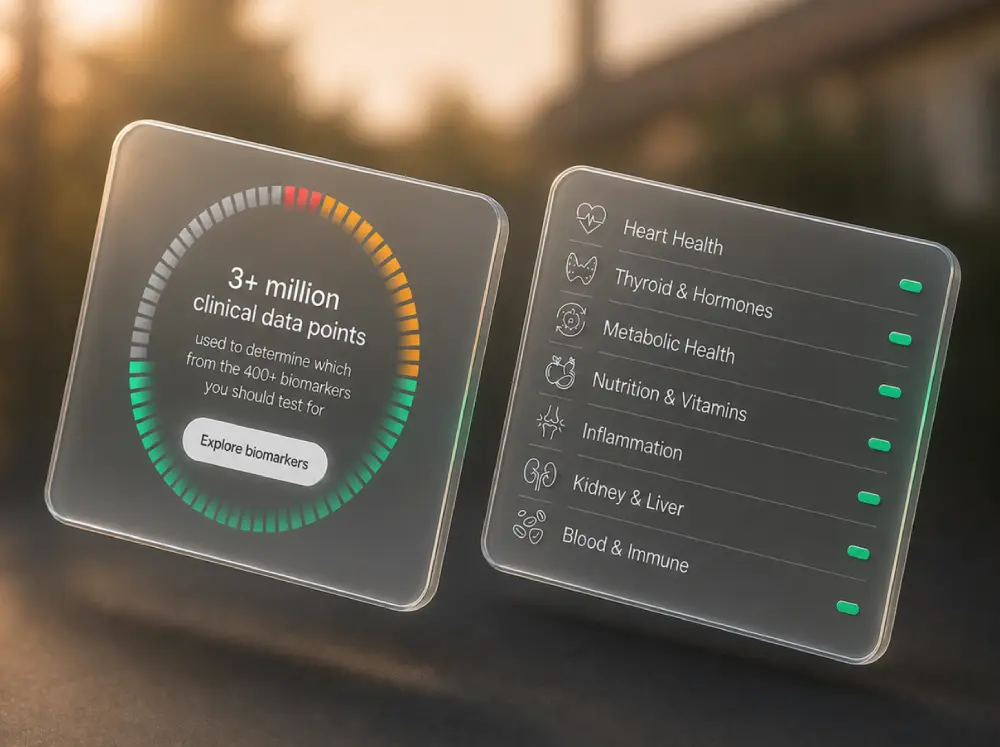
UPIE cross-references the full profile against 3+ million clinical data points of clinically approved profile-effect rules — on the order of 830+ active rules as of mid-2026, each with a resolved citation key and clinical review record. Rules consider combinations: age and smoking, country and latitude-related context where evidence supports it, medications, chronic conditions, surgeries, family patterns, and latest lab thresholds. Every marker your profile qualifies for surfaces as required or optional — typically around 20 core markers on realistic profiles, but not artificially capped. See the right-sized testing guide, not an engine limitation.
What AI does — and does not do
AI in Findings explains patterns, summarises your picture in plain language, and answers questions in chat. It does not choose which screening topics appear, retest intervals, gap lists, or clinical/optimal range boundaries. Those come from seeded rules reviewed before they reach users.
- AI may inaccurately paraphrase a trend — chat footers remind you to verify with your clinician[5]
- Scoped AI overviews are cached per surface and invalidated when underlying biomarker or profile data changes
- Insight threads seed from overviews but do not create new clinical orders
- We do not train models on your lab data — stated in Privacy Policy and product UI
Profile personalization and evidence tiers
Beyond population screening topics, Findings applies profile effect rules — deterministic adjustments from smoking history, body composition, alcohol use, ethnicity, reproductive history, sleep and shift work, medications, occupation exposures, and latest lab values. These rules can:
- Shift optimal biomarker targets — for example, tighter LDL discussion bands when cardiovascular guidance frames risk around age, statin use, and smoking pack-years[6]
- Apply retest multipliers — shorter follow-up when monitoring evidence supports it after a levothyroxine dose change (TSH recheck about 4–8 weeks)[7]
- Re-rank plan topics and surface occupational or lifestyle discussion prompts with citations
- Flag gaps when a marker relevant to your profile has never been tested
Each effect rule carries an evidence tier (A/B/C), merge policy, and clinical review record. Rules compose — multiple signals can apply to the same marker without silently overwriting each other. NICE and similar bodies emphasise transparency about evidence quality when recommendations are applied to individuals[8]; our tier labels serve the same disclosure function inside the product.
Lab and panel context
When you upload a lab report, a separate panel context layer interprets what kind of panel you had — annual employer screen, lipid-only, thyroid panel, and so on — and whether markers are comparable across uploads. Context rules can suppress misleading gap prompts when a marker was never expected on that panel type, add comparability footnotes when assay methods differ, and prioritise follow-up topics that fit the draw you actually received.
Occupation and exposure flags from your profile feed the same engine, so work-related monitoring discussions sit beside population screening — always as prompts worth discussing with your clinician or occupational health provider, not compliance claims. Tumour markers, when present on uploads, are tracked for longitudinal history only; they are not interpreted for cancer diagnosis, screening, or staging in the product.
Units, methods, and cross-lab history
International reports use different units and assay methods. OCR extraction, unit normalisation (mg/dL ↔ mmol/L, ng/mL ↔ nmol/L), and method notes let you stack years of labs in one timeline — useful when you change countries or laboratories between checkups[9][10]. The FDA and CDC both note that reference intervals and assay performance vary between laboratories[11]; we store the lab’s printed clinical band separately from Findings-calculated optimal targets.
Clinical range vs optimal range — computation
Labs print one population reference band on the page — often not personalised to the individual’s age on consumer panels. Findings stores the lab’s printed clinical band separately and computes optimal targets from profile-effect rules where published evidence supports adjustment. Both zones render on the range bar. Example: LDL inside the lab band may still exceed targets cardiovascular guidance discusses for a given risk profile and statin use[6]; HbA1c 5.7–6.4% maps to prediabetes under ADA criteria — a classification distinct from the assay flag[3]. Dual ranges surface that distinction without diagnostic claims.
Citations and clinical review
Each active prevention, protocol, and profile-effect rule links to a citation_key in our registry. Rules carry a clinical review status (draft / approved / deprecated). Only approved rules are shown in production plans. Continuous integration validates that every active effect rule resolves to a citation before release — a gate aligned with the Institute of Medicine standards for trustworthy guidelines: explicit evidence, transparent methods, and conflict management[12].
- Prevention and checkup protocol rules cite USPSTF, CDC, and specialty society sources where applicable[1]
- Profile-effect packs cover smoking tiers, family history, pregnancy, sleep, occupation, and lab thresholds
- Mechanism expansion (one- to two-hop) connects related markers when evidence graphs support it — still rule-driven, not LLM-inferred
- Plan items in the app render citation links you can open — not footnotes generated at read time
As of June 2026: 830+ clinically approved profile-effect rules, each with review metadata and a resolved citation key. Prevention and checkup protocol rules follow the same registry. Named clinical advisors will be listed publicly when the external review programme publishes its roster.
Limitations — what we are not
Findings is for personal organisation and education — not diagnosis, treatment, cure, or emergency care. Plans use hedged language and cite published guidance; the clinician remains the provider of care. Screening topics are discussion prompts, not orders from software. Reference ranges and optimal zones are compiled from published literature and may not match your laboratory’s assay methods or your clinician’s judgment — as stated in our Terms of Service. For regulatory positioning, AI transparency, and privacy practices, see the Trust center and Important information.
Frequently asked questions
No. Findings organises published screening and monitoring guidance for individual profiles. It does not diagnose, treat, cure, or prevent disease, and it is not a substitute for care from a qualified clinician.
Only if their state differs — uploads, medications, acknowledgements, or biomarker trends. The engine is deterministic: identical inputs produce identical outputs.
When guideline sources publish meaningful changes, our clinical content workflow reviews affected rules. Approved updates ship through the normal release process; plans recompute when profile hash or catalog version changes.
No. AI narrates and explains; it does not add or remove screening topics, change retest intervals, or alter range boundaries. Chat may be wrong — verify important conclusions with your clinician.
UPIE ranks every marker your profile qualifies for under published guidance — required vs optional tiers, not one flat mega-panel. Median core count on fixture profiles is ~20; richer clinical profiles can be substantially higher.
The Trust center and Privacy Policy describe data handling, subprocessors, AI transparency, and regulatory positioning. We do not sell your health data, never use personal health data for advertising, and do not train models on your labs.
References
- 1.U.S. Preventive Services Task Force. Grade Definitions.
- 2.GRADE Working Group. GRADE handbook for grading quality of evidence and strength of recommendations.
- 3.American Diabetes Association. Diagnosis and Classification of Diabetes: Standards of Care in Diabetes—2025.
- 4.U.S. Preventive Services Task Force. Methods and Processes.
- 5.U.S. Food and Drug Administration. Artificial Intelligence and Machine Learning in Software as a Medical Device.
- 6.Grundy SM, et al. 2018 AHA/ACC Guideline on the Management of Blood Cholesterol. Circulation.
- 7.Jonklaas J, et al. Guidelines for the Treatment of Hypothyroidism — American Thyroid Association Task Force. Thyroid (2014).
- 8.NICE. Making decisions using NICE guidelines.
- 9.National Institutes of Health, MedlinePlus. Understanding Laboratory Tests.
- 10.KDIGO 2024 Clinical Practice Guideline for the Evaluation and Management of Chronic Kidney Disease.
- 11.Centers for Disease Control and Prevention. Clinical Laboratory Improvement Amendments (CLIA).
- 12.Institute of Medicine. Clinical Practice Guidelines We Can Trust (2011).
- 14.U.S. Preventive Services Task Force. A & B Recommendations.
- 15.Whelton PK, et al. 2017 ACC/AHA Guideline for High Blood Pressure in Adults. Hypertension.
- 16.National Institutes of Health, Office of Dietary Supplements. Vitamin D — Health Professional Fact Sheet.
- 17.American Thyroid Association. Clinical Practice Guidelines.
- 18.2026 ACC/AHA Guideline on the Management of Dyslipidemia. JACC.
- 19.Trinder M, et al. Measurement of Lipoprotein(a): A Once in a Lifetime Opportunity. JACC (2022).
- 20.U.S. Preventive Services Task Force. Screening for Prediabetes and Type 2 Diabetes (2021).