

Right-sized testing vs. 100+ test bundles
Key takeaway
Mega-panels feel thorough because length is easy to sell. Published screening guidance matches tests to age, sex, risk, and medications — and warns that unindicated testing adds false positives and follow-up cascades, not clarity.
Read more
Findings guides are written for general education and reviewed by qualified health professionals before publication. They are not medical advice.
Screening guidance matched to your risks, from the world’s leading health institutions:


Many health apps sell the same 100+ blood tests to almost every adult, then show one simple score — for example a “biological age.” Official screening guidance picks which tests you need and when to repeat them. Findings follows that guidance for your risks instead. This guide is about the market and the medicine behind that contrast: why volume sells, what official bodies recommend instead of “test everything,” and the real cost of unindicated markers. It does not walk through the product — see the health plan guide for that, or the methods guide if you want the engine architecture.
Why volume sells — and why it is not the same as good care
Many bundled health memberships are built around a long test list: the more blood tests on the form, the more complete the product feels. Dashboards fill with numbers. A biological age score turns labs into a simple headline. That business model rewards length — not whether each test would change what you and your doctor discuss at the next visit.
The question that matters is smaller: for your age, sex, medications, and family history, which tests does official guidance suggest — and which would add noise? A 37-year-old with no chronic conditions and a 62-year-old on warfarin with early heart disease in the family should not get the same starter list — yet 100+ test bundles often look nearly identical.
Guidelines exist for a reason
Bodies such as the US Preventive Services Task Force, ESC, NICE, and specialty societies publish who benefits from which screen at which age — not “test every biomarker on every adult every year.”[1] Screening intervals, risk thresholds, and follow-up cadences are evidence-weighted for populations and then applied to individuals with judgment.
- Statin use for primary cardiovascular risk is framed around 10-year risk in adults 40 to 75[2]
- Prediabetes and type 2 diabetes screening repeats about every three years when results are normal[3]
- Colorectal screening now begins at age 45 rather than 50[4]
A 100+ test bundle skips that logic by default: the same LDL stack, liver enzymes, micronutrients, and tumour markers for almost every member. That is the product category Findings rejects — indicated tests for your profile, not the longest requisition that fits on one page.
The cost of unindicated tests
When disease prevalence is low, many abnormal results are false positives or variants of uncertain significance. Patients still search them, repeat labs, and pursue cascades — emotionally and financially taxing.[5] More markers on the page does not automatically mean more clarity; it can mean more chart noise.
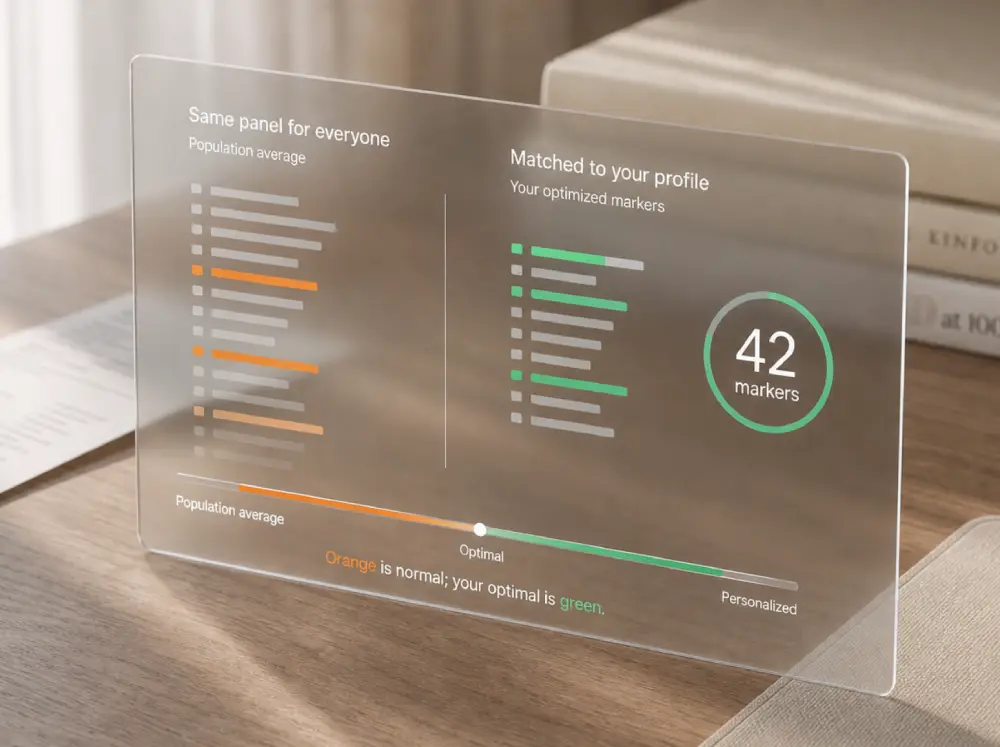
The same panel for everyone
Employer and insurance checkups optimise for throughput: a bundle that works for billing and population averages. They are not built to match screening intervals to your medications, family history, and country one person at a time. A 37-year-old with no chronic conditions and a 62-year-old on warfarin with early heart disease in the family often receive nearly the same line items — because the system was never designed to personalise at that granularity.
Bundled wellness startups inherit the same logic at a higher price point: one long requisition, one dashboard, one biological-age headline. Right-sized testing is the opposite claim — which markers and when, matched to evidence for someone like you, not how many fit on one form.
How Findings applies this — without re-selling the product
Findings is built on the premise above: your marker list should trace to published screening and monitoring guidance for your profile, not to the longest SKU a lab can bundle. Membership is software-only — you arrange draws at any lab and upload when ready. We do not sell blood or mark up a fixed mega-panel.
The how — rule engine, citation registry, deterministic evaluation — is documented on the methods guide. The experience — profile, gaps, dual ranges, retest calendar across decades — is the health plan guide. This page stops at the philosophy: indicated tests beat volume.
Frequently asked questions
Thorough means closing the gaps your profile implies — not maximising line items. Published guidance prioritises indicated screens and monitoring labs; adding dozens of unindicated markers often adds noise, not depth.
When disease prevalence is low, many abnormal results are false positives. Patients still search them, repeat labs, and pursue cascades — emotionally and financially taxing. Guidelines exist partly to avoid that harm.
This guide is the critique of mega-panels and the case for indicated testing. The health plan guide walks through what Findings does with your profile, uploads, gaps, and retest timing across decades — the product journey, not the market argument.
The methods guide is for researchers and clinicians who want the architecture — citation registry, deterministic rules, evidence tiers, and AI boundaries. This page does not describe the engine; it explains why volume is the wrong north star.
No. Findings is software-only — you test at any lab and upload. We do not sell or bundle blood draws. See the health plan guide for how uploads compound over time.
References
- 1.U.S. Preventive Services Task Force. A & B Recommendations.
- 2.U.S. Preventive Services Task Force. Statin Use for the Primary Prevention of Cardiovascular Disease in Adults (2022).
- 3.U.S. Preventive Services Task Force. Screening for Prediabetes and Type 2 Diabetes (2021).
- 4.U.S. Preventive Services Task Force. Colorectal Cancer: Screening (2021).
- 5.Korenstein D, et al. Overuse of health care services in the United States. Archives of Internal Medicine (2012).